

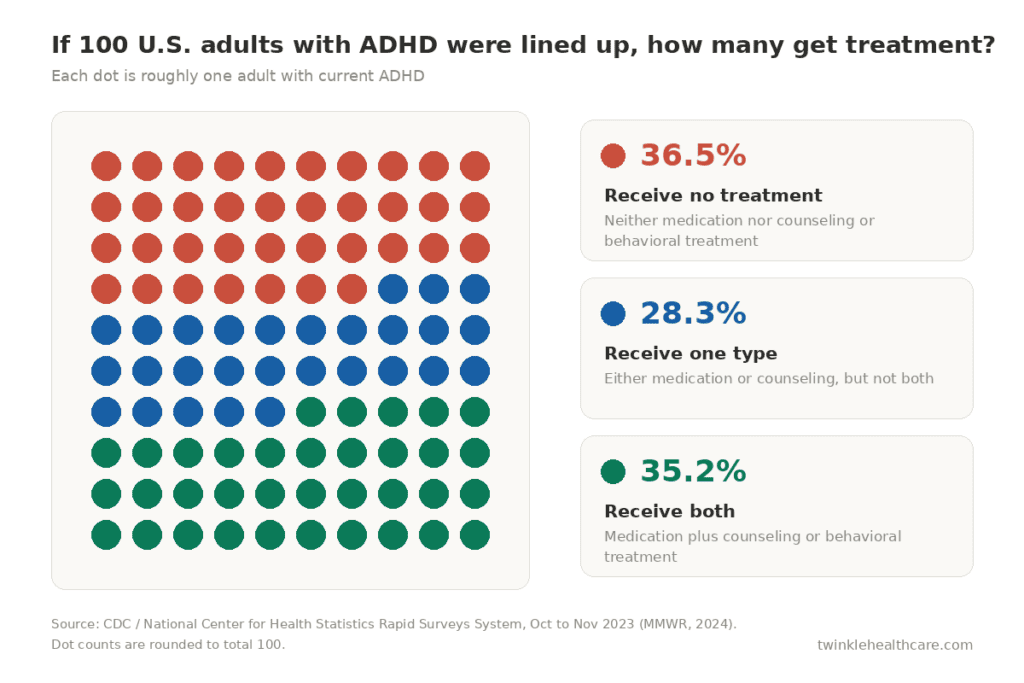
The adult ADHD treatment gap is the difference between the number of U.S. adults who have a current ADHD diagnosis and the number who actually receive treatment: in the CDC’s most recent national estimate, 36.5% of adults with current ADHD were receiving neither medication nor counseling or behavioral treatment. That figure comes from a CDC survey conducted in October and November 2023 and published in 2024.
Picture 100 American adults who currently have ADHD. About 36 of them are getting no treatment of any kind. About 35 are getting both medication and counseling or behavioral treatment. The remaining 28 or so are getting one or the other. That is the whole picture of adult ADHD care in the United States, and it has a very uneven middle.
The same survey estimated that 15.5 million U.S. adults (6.0%) have a current ADHD diagnosis, and that more than half of them first received the diagnosis as adults. This guide looks at the four places where people most often fall out of care, what is changing about telehealth access before the end of 2026, and how to get back on track.
Why Do So Many Adults With ADHD Go Without Treatment?
There is no single reason, and the CDC survey measured whether people were receiving treatment, not why they were not. What the data and the surrounding policy landscape do show are four recurring barriers. Think of them as four doors that adults have to get through, any one of which can close.
Door One: Getting a Diagnosis in the First Place
More than half of adults with current ADHD (55.9%) first received the diagnosis at age 18 or older, according to the CDC report. For many of them, that means decades of symptoms that were explained away as stress, disorganization, or personality. Because ADHD criteria require evidence that symptoms began in childhood, adults often have to reconstruct their history through old report cards and family memories, which is a real hurdle on its own. We cover that process in why more adults are diagnosed with autism and ADHD later in life.
Door Two: Getting the Medication
About half of adults with ADHD (50.4%) were prescribed ADHD medication in the previous 12 months, according to the CDC. Roughly a third took a prescription stimulant, and 5.9% took a nonstimulant. Among those taking stimulants, 71.5% reported difficulty filling a prescription because the medication was unavailable.
That last number is striking. Even for adults who cleared the diagnosis door and the prescription door, the pharmacy counter became a third obstacle, which is a reason some people stop treatment even though they would prefer to continue. Those figures reflect 2023, when stimulant shortages were at their peak, so supply conditions may differ for you today.
Door Three: Staying Connected to Care
About half of adults with ADHD have used telehealth for ADHD services, according to the CDC report, which noted that pandemic-era telehealth policies expanded access to diagnosis and medication. For people with demanding jobs, caregiving duties, or no nearby specialist, virtual visits are often what makes ongoing care possible at all.
That door is the one with a date attached to it, which we cover in the next section.
Door Four: Believing Treatment Is for You
Some adults never pursue care because they assume ADHD is a childhood condition that should have resolved, or that their struggles are a character problem. Treatment is available for adults, and the National Institute of Mental Health notes that it can reduce symptoms and improve functioning. The most common options are medication, often a stimulant, and psychotherapy such as behavioral therapy or cognitive behavioral therapy.
What Is Happening to Telehealth ADHD Prescriptions on December 31, 2026?
The federal flexibilities that allow clinicians to prescribe controlled medications, including ADHD stimulants, by video visit without a prior in-person exam are currently set to expire at the end of the day on December 31, 2026. The Drug Enforcement Administration and HHS issued a fourth temporary extension in late 2025, and, according to HHS’s telehealth guidance, those flexibilities cover Schedule II through V controlled substances through December 31, 2026. ADHD stimulants fall into Schedule II.
Here is where things stood as of mid-November 2026, based on what we could confirm:
- The DEA’s proposed permanent replacement, called the Special Registrations for Telemedicine rule, was still under federal review, with the government’s regulatory agenda targeting November 2026. We did not find a published final rule.
- Health policy groups have publicly asked the DEA to issue a fifth temporary extension through 2027. We did not find one issued yet.
- If neither a final rule nor an extension takes effect, the long-standing federal requirement for an in-person evaluation before prescribing controlled substances by telemedicine would generally return on January 1, 2027.
- The previous extension was published on December 30, 2025, one day before the prior flexibilities were set to lapse, so a late resolution would not be unusual.
Rules like these can change quickly, and state law can add its own requirements on top of federal rules. Please verify the current status with your prescriber, the HHS page above, or the DEA directly before making plans.
If you currently get ADHD medication through telehealth, a few practical steps make sense:
- Ask your prescriber how their practice is planning for the possible change, and whether an in-person visit should be scheduled before the end of the year.
- Check your refill timeline so a gap in appointments does not turn into a gap in medication.
- Do not stop or change your medication on your own. Talk to your prescriber first, since abrupt changes can cause problems.
What Counts as Treatment, Beyond Medication?
The CDC’s 36.5% figure counts adults who received neither medication nor counseling or behavioral treatment. That definition matters, because treatment is broader than a prescription.
Medication. Stimulants are the most commonly used, and nonstimulants are an option for people who cannot take or prefer not to take stimulants. For a plain-language overview, see how ADHD medication works in adults.
Psychotherapy and behavioral treatment. CBT adapted for adult ADHD and skills-based approaches to planning, time management, and emotional regulation address the daily patterns that medication does not fully change.
Practical supports. Structured routines, reminders, and workplace adjustments help many adults, and some find tracking tools useful, which we cover in why adults are tracking focus like fitness. Adults who work can also look at what formal accommodations are available, which we cover in what employers are getting wrong about neurodiversity.
Not everyone with ADHD wants or needs medication, and choosing not to take it is a legitimate decision. The gap this post describes is not about people who have weighed their options and decided. It is about people who never got a real chance to.
Why Closing the Gap Matters
ADHD has measurable effects beyond focus and productivity. In our overview of ADHD and physical health risks, we cover how the condition is associated with sleep, metabolic, and cardiovascular concerns, and in ADHD and chronic pain we look at the overlap with pain conditions. In both cases, addressing ADHD is one part of addressing the wider health picture, which is a good reason not to treat a lapse in care as a minor inconvenience.
A Practical Path Back Into Care
If you have gone without treatment, whether you were never diagnosed, were diagnosed and lost access, or have simply been putting it off, this sequence keeps the process manageable:
- Gather what you can about your childhood. Old report cards, teacher comments, and a parent or sibling’s memories help an evaluator confirm that symptoms began early.
- Book an evaluation with a clinician who works with adults. Many offer telehealth, but ask how current telehealth rules affect prescribing.
- Ask for the full treatment menu. Medication is one option. Ask about therapy and skills support as well.
- Plan for refill logistics. Ask about pharmacy availability, refill timelines, and how your prescriber handles shortages.
- Review the plan after a few weeks. Dosing and fit often need adjustment, and a good prescriber expects that.
Frequently Asked Questions
How many adults with ADHD receive no treatment? According to a CDC survey conducted in October and November 2023, 36.5% of U.S. adults with current ADHD were receiving neither medication nor counseling or behavioral treatment, which is about one in three.
How many adults have ADHD in the United States? The same CDC survey estimated that 15.5 million adults, or about 6.0% (roughly 1 in 16), have a current ADHD diagnosis. More than half of them were first diagnosed as adults.
Why do so many adults struggle to fill ADHD prescriptions? In the 2023 CDC survey, 71.5% of adults who took stimulant medication reported difficulty filling a prescription because the medication was unavailable, reflecting the national stimulant shortage at the time. Supply conditions can change, so ask your pharmacy and prescriber about current availability.
Can I still get ADHD medication through telehealth in 2026? Yes, under current federal flexibilities, which allow prescribing of Schedule II through V controlled medications by video visit without a prior in-person exam through December 31, 2026. What happens after that date depends on whether the DEA finalizes a permanent rule or issues another extension, so confirm the latest status with your prescriber.
What happens if the telehealth flexibilities expire? If no final rule or extension takes effect, the federal requirement for an in-person evaluation before prescribing controlled substances by telemedicine would generally return on January 1, 2027. Some patients may need an in-person visit to continue receiving stimulant prescriptions.
Is ADHD treatment only medication? No. Treatment can include medication, psychotherapy such as CBT, skills coaching, and practical supports. The CDC’s treatment figures count counseling or behavioral treatment alongside medication.
I was never diagnosed as a child. Can I still be evaluated as an adult? Yes. More than half of adults with current ADHD were first diagnosed in adulthood. An evaluator will typically look at your developmental history and current functioning to determine whether the diagnosis fits.
How Twinkle Healthcare Can Help
At Twinkle Healthcare in San Antonio, we help adults find their way into care, whether that means a first evaluation, restarting treatment after a gap, or sorting out how changing prescribing rules affect an existing plan.
Our services include:
- ADHD and Autism Testing for Adults: Evaluations that look at developmental history and current functioning, including for adults who were never assessed as children
- Medication Management: Individualized, closely monitored treatment, including help planning refills and follow-up
- Adult Psychiatry: Coordinated care for adults whose ADHD overlaps with anxiety, depression, sleep problems, or other health concerns
- Telehealth: Convenient access for adults with busy schedules, with guidance on how current prescribing rules apply to your care
If you have been wondering whether it is too late or too complicated to get treatment, we are glad to talk it through.
Serving San Antonio and surrounding areas | Telehealth available

