

ADHD is not only a condition of attention and impulse control. Large population studies now show it is associated with meaningfully elevated rates of obesity, type 2 diabetes, cardiovascular disease, chronic pain, and sleep disorders, and with a shortened life expectancy driven primarily by modifiable, treatable factors rather than ADHD itself. This is the focus of this year’s official ADHD Awareness Month campaign, themed “ADHD at the Center,” which runs through October and specifically highlights how deeply ADHD is connected to the rest of the body, not just the brain.
Here’s the number that should reframe how seriously this gets taken: a landmark 2025 matched cohort study published in the British Journal of Psychiatry found that men with diagnosed ADHD lost approximately 6.78 years of life, and women lost 8.64 years, compared to matched peers without the condition. The researchers who conducted this UK-wide study called the findings deeply concerning, while being careful to note something equally important: these reduced life expectancies were likely caused by modifiable risk factors and unmet support and treatment needs, not ADHD as an unchangeable brain state. This is, in the most literal sense, a treatable life-shortening condition.
Why the Brain-Body Connection Gets Overlooked
ADHD has historically been treated almost entirely as a behavioral and cognitive condition, something that affects school performance, work focus, and relationships, with physical health rarely part of the conversation. That framing is now measurably outdated.
A large-scale 2021 study tracking 4.8 million people found that 34 out of 35 physical health conditions examined were more common in people with ADHD than in the general population, spanning respiratory, metabolic, digestive, cardiovascular, and joint-related systems. Researchers describe this pattern as multimorbidity, when multiple chronic conditions cluster together in the same person, and ADHD now sits at the center of one of the more consistent multimorbidity patterns in psychiatric research.
The mechanism isn’t mysterious once you understand what connects these systems. ADHD involves documented differences in dopamine and norepinephrine regulation, systems that also play a direct role in appetite regulation, pain perception, inflammatory response, and sleep-wake timing. A brain difference that affects attention is, biologically, never going to stay contained to attention alone.
The Specific Physical Health Risks, and What’s Driving Each One
Cardiovascular Disease and Type 2 Diabetes
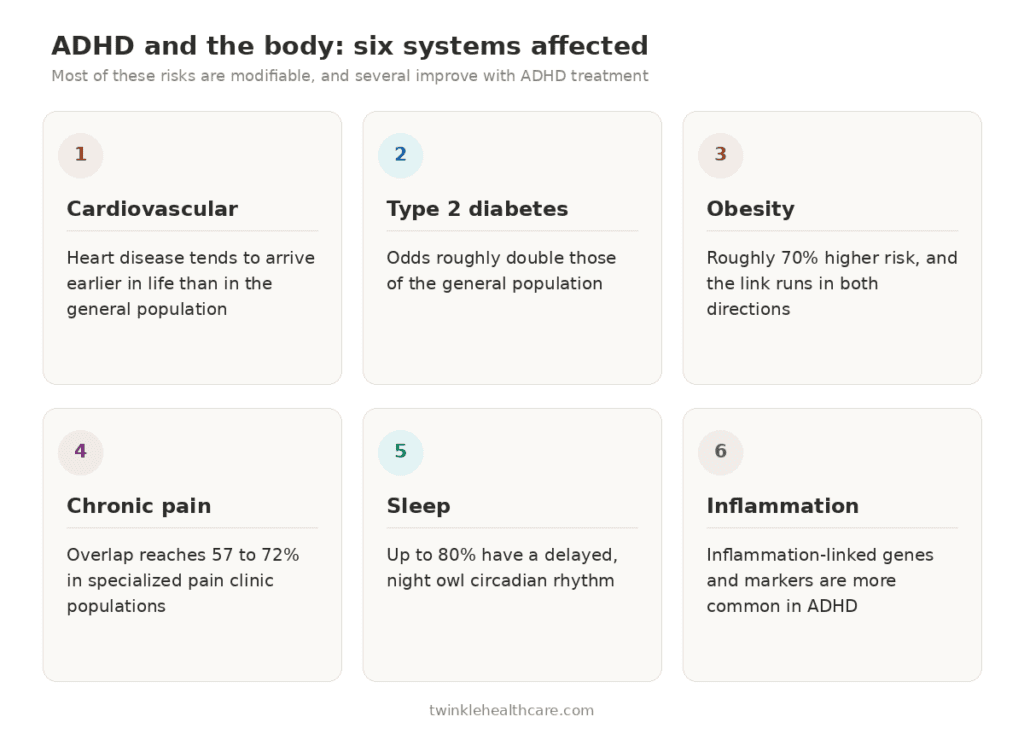
Adults with ADHD face a meaningfully elevated cardiovascular burden, and it tends to arrive earlier in life than it does in the general population. Large registry studies show adults with ADHD are at increased risk for type 2 diabetes, with odds roughly double that of the general population, and appear to develop cardiovascular disease earlier in life than their peers, pointing to a dual burden of psychiatric and physical health risk starting from a young age.
A separate 2026 UK cohort study tracking participants to age 58 found that childhood ADHD problems were associated with a higher risk of premature mortality, and that this risk was largely explained by two specific, modifiable cardiovascular risk factors: obesity and smoking in mid-life. The researchers were explicit about what this means practically: aggressive management of smoking and obesity should be a clinical priority specifically for people with ADHD, not a generic health recommendation applied uniformly to everyone.
Obesity and Metabolic Syndrome
ADHD is associated with elevated obesity risk, roughly 70 percent higher than the general population, and this relationship appears to run in both directions. Executive function differences that affect impulse control and planning make consistent eating patterns and meal planning genuinely harder to sustain, while the resulting weight gain and metabolic strain can, in turn, worsen attention and energy regulation, creating a cycle that’s significantly easier to interrupt with proper ADHD treatment than most people realize.
Chronic Pain
This is one of the more surprising and consistently underrecognized connections in recent research. A 2026 scoping review found that ADHD symptoms are associated with greater pain severity and functional impairment, with comorbidity rates reaching as high as 57 to 72 percent in specialized pain clinic populations, far higher than would be expected by chance. One prospective cohort study found that for each additional ADHD symptom a person had, their odds of moderate-to-severe pain interference six months later increased by 52 percent.
Researchers believe this connection runs through shared neurobiology: central sensitization, the nervous system’s tendency to amplify and prolong pain signals, and norepinephrine dysregulation appear to affect both ADHD symptoms and pain perception simultaneously, rather than being two unrelated conditions that simply happen to co-occur.
Sleep Disorders
Up to 80 percent of people with ADHD are night owls, with a significantly later natural sleep rhythm than the general population, and the relationship between ADHD and sleep is explicitly bidirectional. Poor sleep worsens ADHD symptoms the following day, and ADHD symptoms themselves- racing thoughts, difficulty winding down, delayed circadian timing, disrupt sleep quality in return, creating a loop that typically requires addressing both sides at once rather than treating either in isolation.
Inflammation and Autoimmune Risk
Genes linked to inflammation are more commonly found in people with ADHD, and elevated inflammatory markers are a consistent finding across ADHD research, with downstream effects extending to autoimmune conditions, inflammatory dysregulation, and even reduced effectiveness of certain medications when systemic inflammation is high. This is a newer area of research, but it adds another layer to why ADHD deserves to be understood as a whole-body condition rather than a purely cognitive one.
The Life Expectancy Number Deserves a More Careful Look
The life-expectancy finding is the most striking piece of this picture, and it’s worth sitting with the nuance rather than just the headline number.
The reduction isn’t uniform across every study; different research groups using different methods have found gaps ranging from roughly 4.5 to 13 years, reflecting real variation in study design, population, and the specific mortality mechanisms being measured. A broader meta-analysis identified a 2.18 times increased mortality risk for people with ADHD overall. What’s consistent across every version of this research, regardless of the exact number, is the explanation researchers consistently point toward: modifiable risk factors like smoking and obesity, and unmet treatment needs, not the neurological condition itself.
This distinction is the single most important thing to take from all of this research. The CDC’s own 2026 data show that about a third of adults with a current ADHD diagnosis are receiving no treatment at all, a gap that, based on the mechanisms described above, isn’t just a missed opportunity for better focus or productivity. It’s a missed opportunity to address measurable physical health risk.
There is genuinely encouraging evidence on this exact point. Large Swedish national registry data found that ADHD medication treatment is associated with an approximately 19 percent reduction in all-cause mortality, a striking, population-level finding that reframes ADHD medication from a tool for managing symptoms into something with a measurable, protective effect on physical health and longevity.
What This Means for How You Approach Your Own Care
If any of this feels overwhelming rather than motivating, that’s worth addressing directly, because the point of this research isn’t to add another source of anxiety to an already full plate. It’s the opposite.
Nearly every risk factor described above- obesity, smoking, sleep disruption, untreated symptoms themselves- is modifiable, and effective ADHD treatment has been shown to directly improve several of them simultaneously. This means a conversation with your prescribing clinician about ADHD treatment is also, functionally, a conversation about your cardiovascular, metabolic, and long-term physical health, not a separate issue to address later.
A few concrete things worth raising directly with your care team, if you haven’t already:
Ask whether your current treatment plan, if you have one, is actually addressing your sleep. Given how bidirectional the ADHD-sleep relationship is, this is often an underaddressed piece of an otherwise reasonable treatment plan.
Bring up chronic pain explicitly, even if it seems unrelated to ADHD. Given how commonly these conditions co-occur, a pain concern you’ve been managing separately may respond better once your ADHD treatment is optimized.
Don’t dismiss weight or cardiovascular concerns as separate from your ADHD care. The research increasingly suggests these aren’t parallel issues requiring entirely separate treatment plans; they’re connected enough that addressing them together, with a clinician who understands both, tends to produce better outcomes.
A Note for Anyone Reading This Who Isn’t in Treatment Yet
If you’ve recognized ADHD traits in yourself for years without pursuing an evaluation, whether from uncertainty, cost, or simply not knowing where to start, this research adds a genuinely different kind of urgency to that decision, one that goes beyond daily functioning and into measurable, long-term physical health.
This isn’t meant to create fear about a diagnosis you don’t yet have. It’s meant to clarify what’s actually at stake in the decision to pursue one, and to make clear that getting evaluated and treated is not simply about improving focus or productivity. Based on the research outlined here, it may be one of the more significant, evidence-backed things you can do for your long-term physical health as well.
Frequently Asked Questions
Does ADHD actually shorten life expectancy? Large cohort studies, including a 2025 British Journal of Psychiatry study, have found reduced life expectancy in adults with diagnosed ADHD, with estimates varying by study but generally ranging from several years to over a decade. Researchers consistently attribute this primarily to modifiable risk factors like obesity and smoking, and to unmet treatment needs, rather than to ADHD itself as an unchangeable condition.
Can ADHD medication actually improve physical health, not just attention? Evidence suggests yes. Large Swedish registry data found ADHD medication treatment associated with approximately a 19 percent reduction in all-cause mortality, and treatment has also been shown to help address several of the modifiable risk factors, including smoking rates and sleep regulation, that drive much of ADHD’s physical health burden.
Why do people with ADHD have higher rates of chronic pain? Research points to shared neurobiology between ADHD and chronic pain, particularly central sensitization and norepinephrine dysregulation, both of which affect how the nervous system processes and amplifies pain signals. Comorbidity rates in specialized pain clinics are as high as 57 to 72 percent.
Is the connection between ADHD and obesity just about impulsive eating? It’s more complex than that. While executive function differences do affect eating patterns and planning, the relationship with obesity also appears to run in the other direction, with metabolic strain potentially worsening attention and energy regulation, suggesting a genuine bidirectional cycle rather than a simple behavioral explanation.
Why are people with ADHD more likely to be night owls? Up to 80 percent of people with ADHD show a delayed circadian rhythm, likely connected to the same dopamine and norepinephrine regulation differences that underlie ADHD’s attention-related symptoms. This relationship runs both ways: ADHD symptoms disrupt sleep, and poor sleep worsens ADHD symptoms the next day.
Should I bring up physical health concerns with my psychiatrist, or just my primary care doctor? Both, ideally in coordination. Given how interconnected ADHD is with these physical health risks, a psychiatrist or prescriber familiar with this research can help ensure your ADHD treatment plan accounts for sleep, metabolic, and cardiovascular factors, rather than treating them as entirely separate from your psychiatric care.
How Twinkle Healthcare Can Help
At Twinkle Healthcare in San Antonio, we understand ADHD as a whole-body condition, not just a cognitive one, and we take the physical health research seriously as part of how we approach adult ADHD care.
Our services include:
- Comprehensive ADHD Testing for Adults: Thorough evaluations for adults who suspect undiagnosed ADHD, particularly given what current research shows about the cost of going untreated
- Medication Management: Individualized, closely monitored treatment that considers your full health picture, including sleep, metabolic factors, and cardiovascular risk, not symptoms in isolation
- Adult Psychiatry: Coordinated care for adults managing ADHD alongside chronic pain, sleep disruption, or other co-occurring physical and mental health concerns
- A Treatment Approach Grounded in Current Research: We stay current on findings like these specifically so your care plan reflects what the evidence actually shows, not outdated assumptions about what ADHD affects
If you’ve been putting off treatment, or wondering whether it’s worth the effort, this research suggests the stakes may be higher, and the potential benefit greater, than you realized.
Serving San Antonio and surrounding areas | Telehealth available

